Young consumers are surrounded by products that are designed to be affordable, accessible and constantly replaced. Fashion and plastic are two particularly visible examples of how modern consumption patterns affect the environment. While clothing allows people to express their identity, plastic has become an essential material across almost every area of everyday life. Both industries, however, are facing growing environmental challenges. This article explores the rise of fast fashion, the differences between fast, slow, sustainable and circular fashion, and the circular solutions that can extend the life of clothing. It then turns to plastic, examining why this versatile material has become such a global environmental challenge and how consumers, businesses and policymakers can contribute to reducing plastic pollution. The aim is to show young consumers that more sustainable consumption does not necessarily mean consuming less of what they enjoy, but thinking differently about what they buy, use and eventually discard.
More than just clothing
The primary role of clothing is to shield our bodies from weather conditions such as cold, wind, rain, or sunlight. However, clothing also serves as a powerful means of self-expression, signalling our profession, favourite sports team, or musical preferences. Textiles are deeply embedded in daily life: from garments and home furnishings to medical supplies, safety gear, construction materials, and transportation. Sadly, our passion for fashion has significant environmental consequences. As the ecological footprint of clothing steadily increases, urgent action is needed to mitigate its impact.
The economic and cultural context
The fashion industry is a global powerhouse. It is a multibillion-dollar sector that drives employment and economic activity worldwide, playing a crucial role in manufacturing, retail, and marketing. For many low-income regions, cotton cultivation is a vital source of income. Beyond economics, the industry shapes culture and social dynamics, influencing how we form our identities and relate to one another. Despite its economic benefits, the industry has undergone a drastic shift in recent years. While textile production has expanded rapidly to meet rising demand, the average lifespan of a garment has significantly decreased.
Fast fashion is out of fashion
Fast fashion and slow fashion represent two fundamentally different approaches to how we make and consume clothes. Fast fashion is a business model focused on the rapid production of low-cost, trend-driven garments. Its goal is to move styles from the runway or social media to stores as quickly as possible, capitalizing on the latest fads to encourage consumers to buy more frequently. This model functions in a predominantly linear (“take-make-dispose”) manner, relying on mass production, cheap labor, and low-quality materials. Consequently, garments are often treated as disposable; estimates suggest that over half of fast fashion items are discarded within a year of production. This cycle creates massive environmental harm through overconsumption and creates a culture of excess waste. A clear example of this is the rise of “ultra-fast fashion” brands that release thousands of new items every day, many made from synthetic fabrics like polyester that take centuries to decompose.
In direct contrast, slow fashion acts as an antidote to this “need for speed.” It is a movement that prioritizes quality, longevity, and ethical production over volume. Instead of chasing weekly trends, slow fashion promotes timeless designs and durable garments that are meant to be worn for years rather than weeks. The core goal is to slow down the production cycle and encourage conscious consumer behavior, motivating people to buy fewer, better-made items that last longer. Specific examples of slow fashion practices include capsule wardrobes and brands that offer lifetime repair warranties, encouraging users to fix a torn jacket rather than replacing it.
While terms like “slow,” “sustainable,” and “circular” are often used interchangeably, they refer to different aspects of the industry. While slow fashion refers specifically to consumption habits and production speeds, sustainable fashion and circular fashion describe the broader systems behind the clothes.
Flooded by plastic
The term “plastics” refers to a broad family of synthetic and semi-synthetic materials known as polymers. While the scientific origins of these materials date back to the 19th century, the true “Age of Plastic” did not begin until the mid-20th century. The turning point was the discovery that plastics could be mass-produced cheaply using fossil fuels as raw materials. From that moment onward, the industry experienced an explosive expansion. This growth was driven by the material’s unmatched versatility, durability, and low production costs. Almost overnight, plastic became the ideal substitute for traditional materials, replacing heavy metal, fragile glass, and expensive wood in countless applications. However, this success has created a global crisis. The widespread use of such persistent materials has led to severe environmental challenges, as our ability to produce plastic has far outpaced our ability to manage the resulting waste.
The accumulation of plastic waste, combined with historically limited recycling efforts, has led to widespread pollution that threatens ecosystems worldwide. Plastic pollution has wide-ranging impacts on ecosystems, animals, and human health due to its persistence and widespread presence. In marine environments, the consequences are immediate and often fatal. Marine animals frequently mistake plastic debris for food or become entangled in abandoned fishing gear, leading to injury, starvation, or death. To address this, the industry faces an urgent need to shift toward circular economy principles. By enhancing waste management systems and redesigning how we use these materials, society can maintain the significant economic value of plastics while drastically reducing their ecological footprint and ensuring long-term sustainability.
How to reduce plastic waste
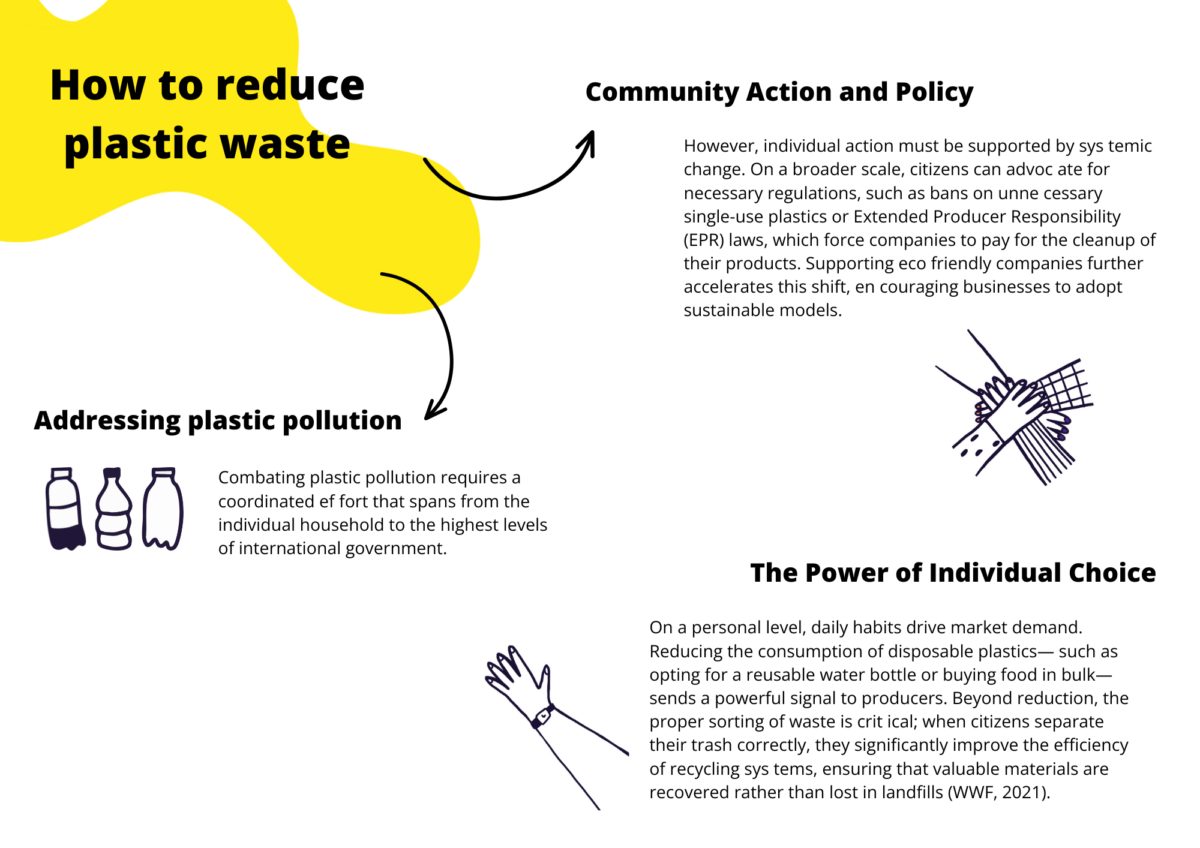
These choices become more meaningful when they are supported by businesses and policies that make circular options accessible. The goal is therefore not simply to ask young people to become “better consumers”, but to create a system in which durability, reuse, repair and circularity become normal parts of consumption.