Consumption is an essential part of everyday life, providing people with goods and services they need for their well-being. At the same time, current patterns of production and consumption are putting increasing pressure on the planet’s ecological systems. Sustainable consumption is about finding a balance between these two realities: ensuring that people have enough to live well without exceeding the limits of the planet. This article introduces the concepts of Planetary Boundaries, Doughnut Economics and Sustainable Consumption Corridors and explores how the circular economy can contribute to more sustainable consumption. A case study of the European Union shows how these ideas are translated into policies and actions, with a focus on priority sectors where the transition towards circularity is particularly important.
Finding a balance
Global consumption patterns are currently putting the planet’s ecological balance at risk. There is no doubt that our “take-make-waste” behavior harms ecosystems. However, consumption is also necessary; it provides us with food, housing, and the tools we need for well-being. The challenge is balancing these two realities. High levels of consumption and production threaten the Earth’s stability, but too little consumption leads to poverty and social injustice.
Planetary Boundaries: The Ecological Ceiling
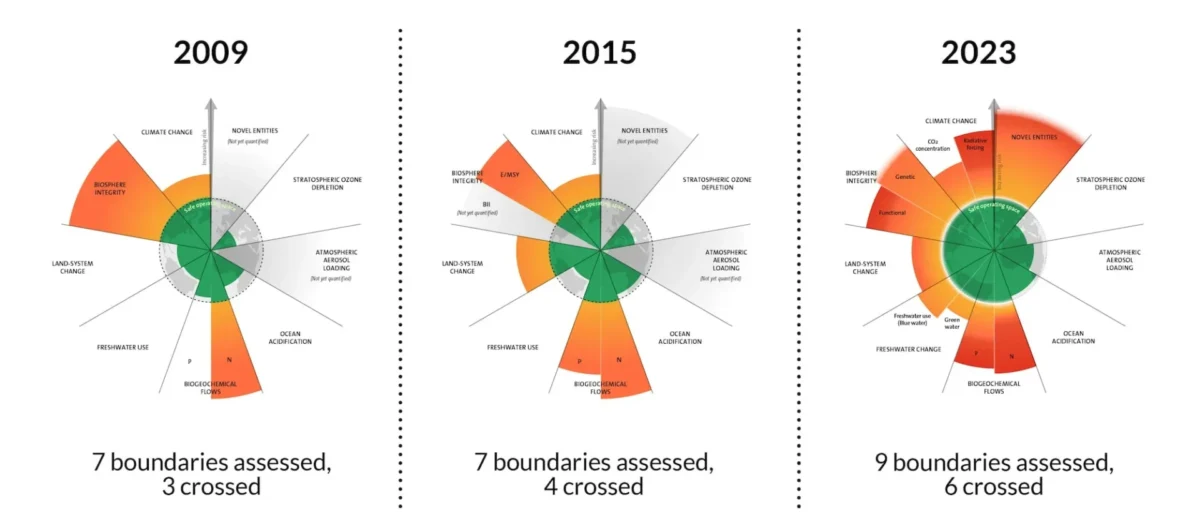
How do we know when we are consuming too much? Scientists monitor this through the concept of Planetary Boundaries. Proposed in 2009 by the Stockholm Resilience Centre (led by Jo han Rockström), this framework identifies nine critical processes that regulate the stability of the Earth (such as climate change, biodiversity loss, and freshwater use). The concept can be understood as an ecological ceiling for human activity. As long as we stay within these boundaries, humanity can operate within a relatively safe space. Surpassing these boundaries, however, increases the risk of irreversible environmental changes. The 2023 update concluded that six of the nine planetary boundaries had already been crossed, meaning that humanity is in an increasingly high-risk zone.
The Doughnut Economy: A Safe and Just Space
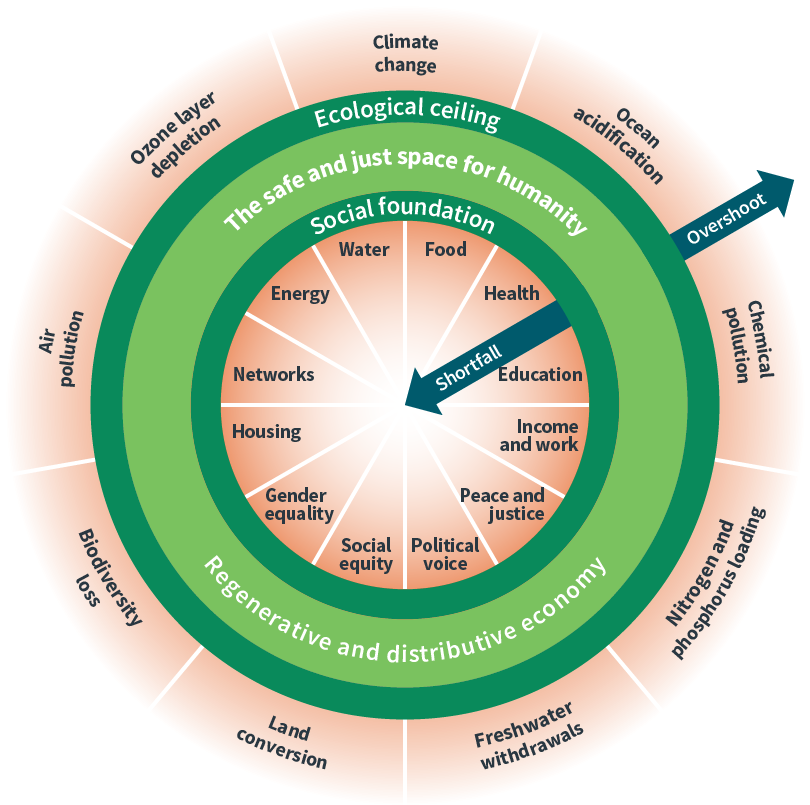
While Planetary Boundaries tell us the maximum we can consume (the ecological ceiling), they do not address the minimum people need to survive. Economist Kate Raworth added this social dimension, creating the Doughnut Economics model. The model combines two limits: The outer ring (ecological ceiling) and inner ring (social foundation). In the outer ring, humans must not overshoot the planetary boundaries, for example through excessive climate change and pollution. In the inner ring, we must not undershoot human needs, such as food, water, health, education and social equity. Between these two limits lies the Doughnut, the safe and just operating space for humanity. It represents a space in which everyone has enough to thrive without putting excessive pressure on the planet. Currently, no government is fully operating within the Doughnut. Most wealthy nations are breaking the ecological ceiling, while many developing nations are falling below the social foundation.
Defining Sustainable Consumption
Sustainable consumption is about finding that balance. Defined at the Oslo Symposium (1994), it means using goods and services to meet basic needs and improve quality of life, while minimizing the use of natural resources and toxic materials so that we do not jeopardize future generations. A helpful new concept for teachers is Sustainable Consumption Corridors. This builds on the Doughnut model by defining a “corridor” of acceptable consumption lifestyles. The floor, or minimum standard, means that every individual must have access to enough resources to live a “good life,” satisfying basic needs such as food, shelter and mobility. The ceiling, or maximum standard, means that there must be a limit on resource use so that one person’s excess consumption does not prevent others, either now or in the future, from having enough. Living “in the corridor” therefore means having enough to live well, but not so much that consumption harms other people or the planet. This perspective also changes how we think about sustainable consumption. It is not necessarily about asking everyone to consume as little as possible. Instead, it is about finding a level of consumption that allows people to meet their needs while remaining within social and ecological limits.