Young people need more than knowledge to contribute to the transition towards a circular economy. They need opportunities to experience sustainability, work with others and apply what they learn to real-life problems. Partnerships with companies, NGOs, universities and other organisations can create these opportunities. From international exchange to practical workshops, there are many ways to connect education with the world outside school. But sustainability should not become another subject simply added to an already crowded curriculum. Instead, it can get integrated into already existing subjects and through real experiences. Building these partnerships takes time, but it can create a network where schools and external partners benefit from each other.
Learning from reality
We asked before what young people need to learn in order to contribute to a circular economy. The answer was more than knowledge. They need to learn how to question, collaborate, create and turn ideas into action. But this raises another question: Where should this learning take place? For generations, we have thought of learning as something that mainly happens at school. A teacher explains. Students listen. They take notes, answer questions and take exams. What if we are the first generation to do it differently? Some things are simply easier to understand when you experience them. You can read about circular business models. Or you can visit a company and see how materials are actually kept in use. An excursion to a sustainable company in your region can show students how resource cycles and design practices are used in practice. One example is EcoBean, which works with coffee grounds to recover valuable materials.
Learning across borders
Local partnerships are valuable, but climate change is a global challenge. Learning should not stay within national borders. Collaborative International Learning (COIL) formats offer students the opportunity to work with young people from other countries. Many universities and NGOs are working on projects with partners from all over the world. International exchange with peers broadens students’ horizons. How is waste handled in other countries? What sustainable solutions exist? Students learn how sustainability is implemented in other countries, practice their intercultural communication and have the opportunity to learn from each other.
Learning by making
Hackathons, makethons, campaigns, repair workshops, digital storytelling formats… There are a variety of formats that can be integrated into school. The gamification approach enables young people to learn through playful and motivating lessons, changing behaviour through self-reflection. Schools can work with companies, NGOs or other organisations for these formats. In that way, students get in touch with real-life problems and develop ideas together. Perhaps they create a new use for a waste material. Perhaps they rethink how a product is designed. Every idea brings value for both sides. The Play Sustain Foundation uses technology to convey the circular economy in an emotionally appealing way. For example in webinars, fashion shows, podcasts and AR/VR tools.
Sustainability belongs everywhere
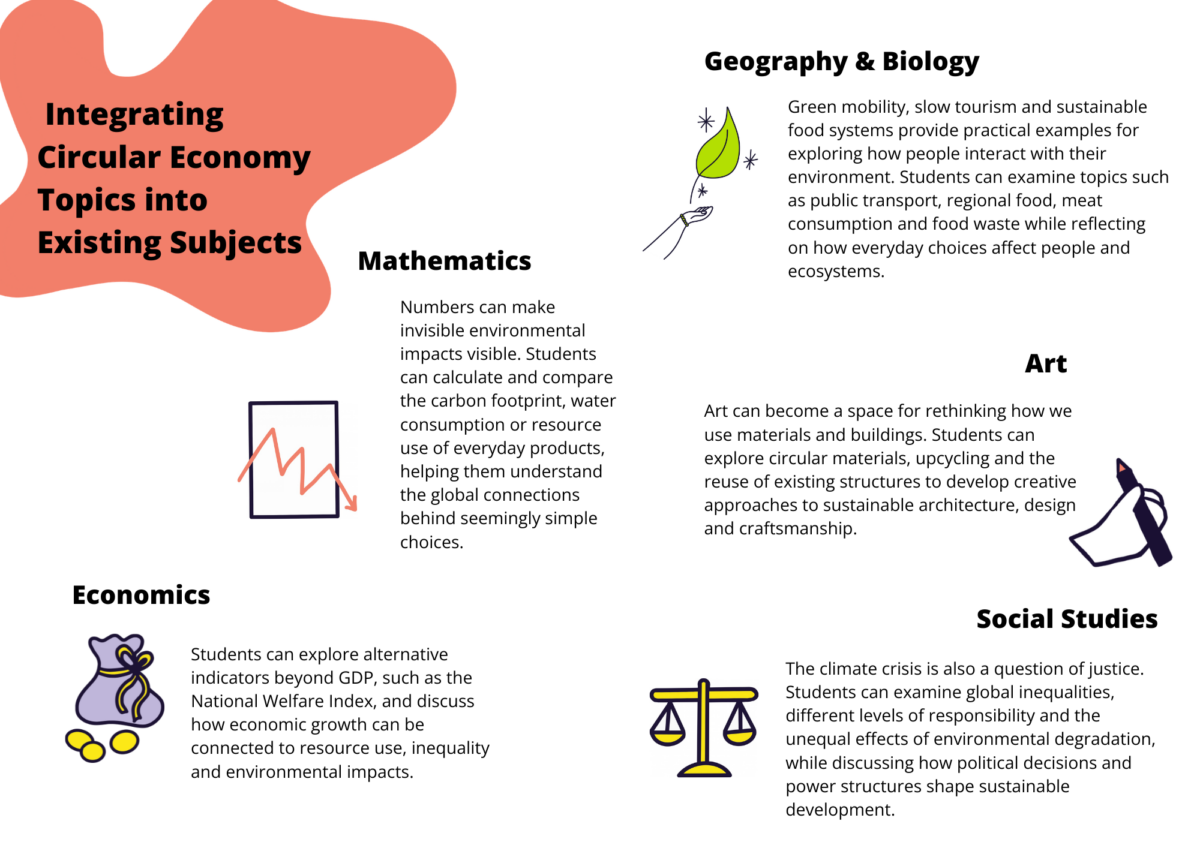
Education is not a linear process, but a transdisciplinary river where every branch of knowledge finds its confluence. Schools are already expected to teach more and more. You might think adding another topic on top would be difficult? Wrong. Circular economy and sustainability cross and enrich all subjects. In order to find sustainable solutions, interdisciplinary learning approaches are crucial. Environmental topics should no longer be confined to geography lessons, they can be embedded in all subjects: from economics, to math and art. This raises students’ awareness of the environmental crisis as an omnipresent and urgent issue.
In economics classes, students should engage with alternative indicators beyond the GDP, such as the National Welfare Index. The higher the material wealth and therefore the GDP of a country, the greater its carbon footprint. GDP and prosperity may rise in the Global North, but so does inequality and environmental degradation. Not everyone has contributed equally to the climate crisis and not everyone is affected by it in the same way. So the climate crisis is inherently also a justice crisis. This makes the topic highly relevant for social studies as well, where global inequalities, ethical implications and power structures can be critically examined.
Even in geography and biology lessons, sustainability issues are often overlooked. Yet, the curriculum can be expanded by integrating current examples from areas such as green mobility, slow tourism and sustainable food systems. Cities can be used as examples to analyse how local mobility encourages travellers to behave environmentally friendly by using rental bikes and public transport. Often the question arises whether a comfortable life that makes travelling possible is compatible with taking responsibility for the environment. Emissions should just not be glamorized. It is important to reflect on one’s lifestyle.
From one project to a network
A single workshop can be inspiring. A company visit can change a perspective. But what happens afterwards? Schools need long-term partnerships with external organisations that can support them over the time. Companies, NGOs and universities can become part of a network that gives students opportunities to experience and practice sustainability. The cooperation works in both directions. External partners bring expertise and real-world experiences into school. Students bring curiosity, creativity and new perspectives. However, building such a network does not happen in the blink of an eye. How do I find external partners? How does a contact turn into a long-term cooperation? Read the next article to find out.