What if the value of a material depended less on what it was originally made for and more on what we could make of it. Reuse challenges the idea that materials become worthless once their initial purpose has been fulfilled. Within the ET CASE project, Re-Use Centers bring this perspective into schools by creating spaces for collecting, sharing and repurposing resources. Through practical workshops, students explore creative ways to reuse everyday materials, while a digital learning platform offers additional opportunities for collaborative idea development.
A Second Life for Things We No Longer Need
Our relationship with resources is often shaped by a simple distinction: what we need and what we no longer need. Once something falls into the second category, its journey frequently ends in the bin. But this way of thinking leaves little room for what could come next. What seems to have reached the end of its life might simply be waiting for a different purpose.
This is the idea behind the Re-Use Centers within the ET CASE project. They are designed as shared spaces within schools where materials can be collected, exchanged and given a second purpose. Inspired by already existing re-use centers models, the concept has been adapted to the educational environment, making it possible to integrate reuse into everyday school activities and the regular curriculum.
Rather than treating reuse as an occasional classroom exercise, the centers aim to establish it as a continuous part of school life. They can support art projects, science experiments and local community initiatives while reducing the amount of material that would otherwise be discarded. More importantly, they create an environment in which students can experience circular economy principles directly.
A Place Where Resources Keep Moving
A Re-Use Center does not require a large space or expensive equipment. What it needs is a clear purpose and a system that makes it easy for people to participate. Therefore, the first step is to identify an accessible room within the school. Shelves, labelled boxes and designated storage areas help organise the collected materials and make them available to those who need them. Drop-off points in classrooms and common areas allow students, teachers and parents to contribute items they no longer use. Local businesses can also become part of the network by donating suitable leftover materials.
The opening of the center can be accompanied by an event introducing its purpose and possibilities to the school community. Teachers and volunteers can then organise regular workshops to demonstrate how collected materials can be transformed into something useful. Over time, feedback from students and other users help identify which materials are needed, which activities work well and where adjustments are necessary.
Keeping the center running also requires some organisational and financial planning. Schools can explore funding opportunities, organise fundraising activities or establish partnerships with local businesses. Measuring how much material is collected, reused or diverted from disposal can further help assess the center’s contribution. What makes this approach interesting is that the center relies on a shared understanding of resources. Students may donate materials they no longer need and later discover something useful that another person has contributed. Teachers gain access to materials for their lessons, while local businesses have an opportunity to pass on resources that might otherwise go unused. It creates a network in which materials continue to circulate.
Workshops Where Old Materials Turn Into New Possibilities
The setting is set, but now students need to explore what reuse actually looks like. The re-use workshops are designed for young people aged 13 to 19, where different activities introduce practical methods such as reusing, repairing and upcycling. The focus is on developing sustainable products and project ideas using materials that are already available and collected through the re-use center.
Each workshop begins with a short introduction to the circular economy and the role of reuse within it. Students then move to the practical task, working individually or in groups to create a project. Once the projects are completed, participants present their results and discuss the process. What challenges did they encounter? Which materials were easiest to work with? And did they look at the materials differently after discovering what could be made from them? A final feedback session gives students the opportunity to share their impressions and reflect on what they have learned.
The upcycling projects do not need to be difficult to make. The simplicity of these activities is part of its appeal. Transforming a T-shirt into a bag or making a notebook out of used paper does not require expensive equipment or materials. It demonstrates that something useful can emerge from resources that are already available. At the same time, the process introduces students to a different way of approaching consumption: before purchasing something new, it may be worth considering what can be made, repaired or reused with what is already there.
A Digital Learning Platform
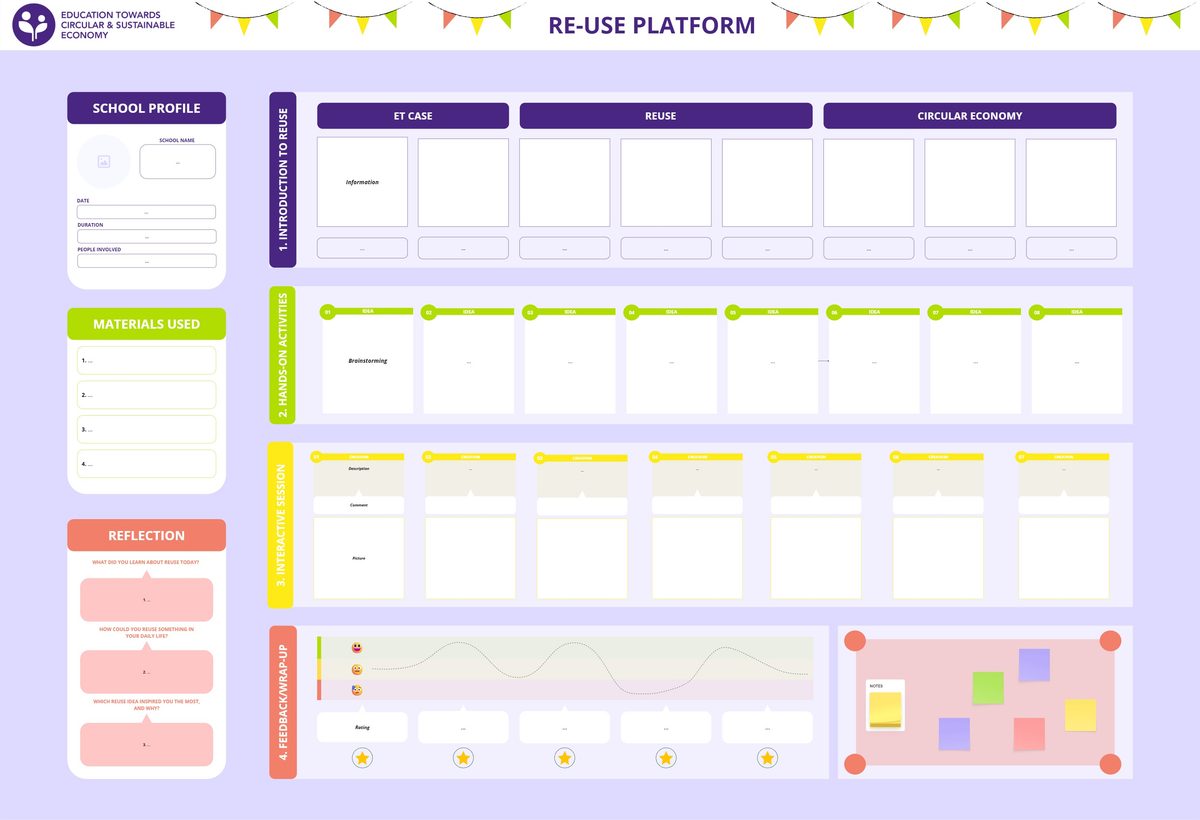
To complement the practical workshop, the ET CASE team also designed a digital learning platform to support collaborative reuse activities. To collect and share ideas, the platform Miro was used, which allows participants to organise thoughts, concepts and resources on a shared visual board. The intention was to provide students a common space where they could contribute their ideas and see what others had developed digitally. Digital tools can expand the possibilities of sustainable education, but their use needs to reflect the actual resources available in schools. Not every student has access to an individual laptop. A hybrid approach of the workshop is therefore recommended, where digital documentation is being added to face-to-face collaboration.
The Re-Use Center with its workshops are built around a simple idea: resources do not have to belong to one purpose. They can be passed on, transformed and used in ways that were perhaps never intended when they were first produced. By creating a space for this exchange, schools can encourage students to question what they consider waste and to recognise the possibilities that might otherwise go unnoticed. After all, a resource is only wasted when we stop looking for ways to use it.