Waste is often treated as the end of a product’s life. But what if what we throw away still has value? Electronic waste contains precious and critical materials that can be recovered and used again, while food waste represents a loss of the resources, energy and labour that went into producing food. This article looks at two very different waste streams and the challenges they create. It explores why electronic waste can become hazardous when improperly managed, why so much food is lost or wasted before it reaches our plates, and how circular economy approaches can turn both into valuable resources. From recycling metals and repairing electronics to food upcycling and recovery, the focus shifts from simply managing waste to preventing it and keeping resources in use for as long as possible.
Waste still has value
Waste is usually associated with something that has reached the end of its useful life. We throw it away because we no longer need it, because it is broken, or because it is no longer considered valuable. But this view can be misleading. Many things we classify as waste still contain materials, nutrients or other resources that could be used again. Two very different examples are electronic waste and food waste. An old smartphone may no longer be wanted, but it can still contain valuable materials. A loaf of bread that is thrown away may seem worthless, but the land, water, energy and labour used to produce it have not disappeared with it. Looking at waste through a circular economy lens therefore changes the question. Instead of asking only “How do we get rid of this?”, we can ask “What is still here, and how can we keep its value?”
E-Waste is not waste
E-waste, or electronic waste, refers to discarded electronic devices and their components, including smart phones, computers, televisions, and household appliances. This category encompasses both functional and non-functional products that are no longer in use, posing significant environmental and health challenges due to the presence of hazardous substances and the complexity of recycling processes. The term covers any electronic product that no longer works or is no longer wanted. E-waste often still contains valuable materials such as gold, silver and copper or even hazardous substances such as lead, mercury and cadmium. If the devices or individual components are disposed of improperly, this can lead to environmental pollution and health risks due to the release of toxic components. If they are recycled, valuable resources can be at least partially recovered and damage minimized. Informal recycling of e-waste can have various harmful effects on health, with children and pregnant women being particularly at risk. Organizations such as the World Health Organization (WHO) estimate that millions of women and children working in the informal recycling sector worldwide could be at risk of hazardous e-waste exposure.
Why recycle electronics?
E-waste should not be seen simply as discarded material, but rather as a valuable resource with significant potential for recovery and reuse. It contains numerous precious and critical materials essential for modern technologies, including electronics and batteries. By approaching e waste as a resource, the need for extracting new raw materials can be reduced, thereby helping to conserve natural ecosystems and decrease environmental degradation. Through recycling, components such as metals, plastics, and glass can be repurposed into new products. For instance, metals from electronic parts may be reused in other electronic devices, while plastics can find a second life in pack aging or construction, lowering dependence on raw materials and diverting waste from landfills. This perspective aligns with the principles of a circular economy, in which materials are reused and reintegrated into the production cycle rather than discarded. Effective e-waste management not only helps reduce environmental harm but also opens up new economic possibilities. It reduces the risks posed by hazardous substances which can be harmful to ecosystems and human health if not managed properly. Recycling also offers a more sustainable and cost-effective alternative to raw material extraction.
Losing more than food
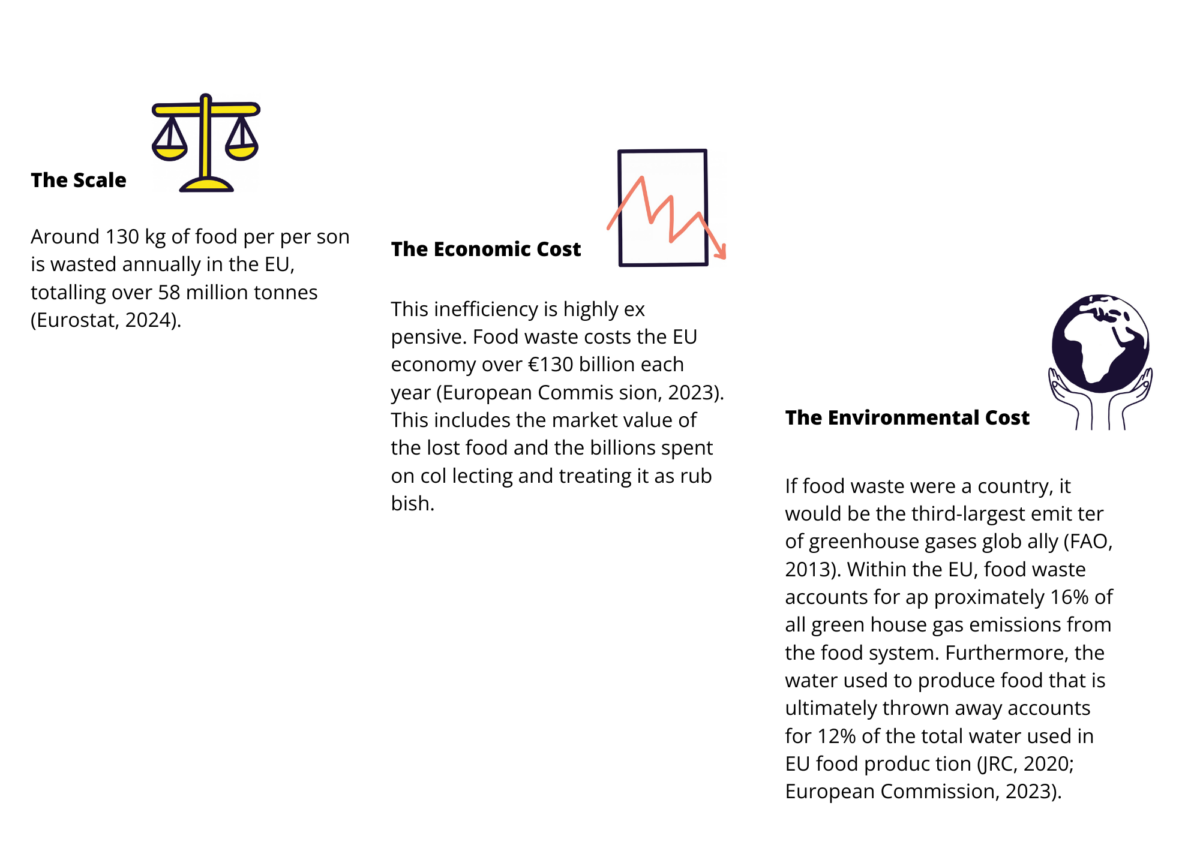
Food waste may look very different from e-waste, but the underlying problem is surprisingly similar. When food is thrown away, it is not only the food itself that is lost. All the resources used to produce, process, transport and store it are lost as well. Globally, approximately one-third of all food produced for human consumption is lost or wasted every year. While a discarded apple or a forgotten loaf of bread might seem insignificant on a personal level, the cumulative global impact is enormous.
Food Loss and food waste are not the same
Not all wasted food is lost for the same reason. Food loss generally occurs earlier in the supply chain, for example during harvesting, storage or transportation. Pest infestations, extreme weather, inadequate refrigeration or insufficient infrastructure can all contribute to losses. In some cases, however, perfectly edible food is lost because it does not meet commercial standards. Fruits and vegetables can be left in fields simply because they are considered too small, too large, crooked or visually imperfect for supermarkets. Food waste, by contrast, occurs mainly further down the chain, including in supermarkets, restaurants and households. Here, human behaviour plays a much larger role. People may buy more fresh food than they can consume, cook portions that are too large or store ingredients incorrectly. Even something as simple as a date label can contribute to unnecessary waste. Consumers sometimes confuse a best before date, which primarily indicates quality, with a use by date, which relates to food safety. Understanding this distinction can help prevent edible food from being discarded unnecessarily.
The Circular Solution for food
The circular economy offers another way of thinking about surplus food. Instead of treating organic materials as waste, they can remain within the biological cycle and retain as much of their value as possible. One approach is upcycling: transforming ingredients that might otherwise be discarded into new, higher-value products. Surplus bread, for example, can be used in brewing, while fruit pulp left over from juice production can become an ingredient for snacks or other food products. Another option is to keep surplus food within the human food system. If food is still safe and edible, it can be redirected to food banks, community organisations or other people who can use it. But the most effective solution is to prevent the waste from being created in the first place. This can mean matching agricultural production and supermarket inventories more closely to actual demand, improving storage and supply chains, changing rigid cosmetic standards for fresh produce and helping households plan their purchases more carefully.